


8 min read • By Dr. Kevin Baharvand, DMD, MS • Updated August 2026
The short answer
Sometimes, and it depends on why it failed. Root canals succeed at a high rate but not one hundred percent of the time, and a failure is not automatically anyone’s fault. Many offices will apply the original fee toward retreatment or an extraction if a tooth fails within a reasonable window, and many will not if the failure came from a fracture or from a final crown that never got placed. The way to avoid the fight is to ask what the policy is before treatment starts.
This question usually arrives with a lot of frustration behind it, and the frustration is fair. You paid for a procedure, you sat through it, and the tooth still hurts or it has to come out anyway.
The honest answer is that it depends on why it failed, and that is not a dodge. Root canals fail for at least five distinct reasons and they do not all point the same direction.
So here is how I would think about it, including the parts that do not favor the dentist.
On this page
Why root canals fail
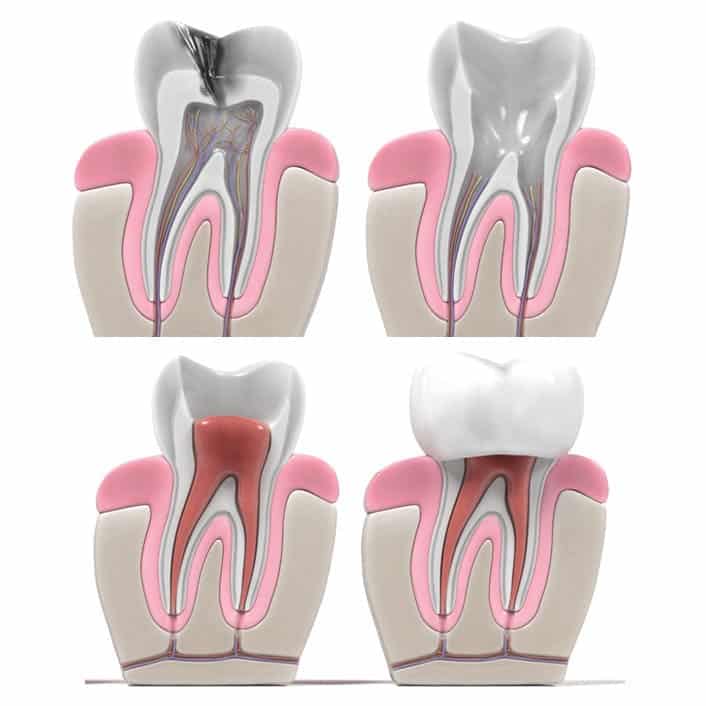
A root canal removes the infected nerve tissue from inside the tooth, disinfects the canal system, and seals it. Success rates are high. They are not perfect, and the anatomy is the reason.
The inside of a tooth is not a straight tube. Upper molars frequently have a fourth canal that is narrow, curved, and genuinely difficult to find. Canals branch, they calcify with age, and some of them are not visible on a standard x-ray at all.
| Why it failed | Is anyone at fault | What usually happens |
|---|---|---|
| A canal was missed, often the extra one in an upper molar | Not necessarily. Some are undetectable without 3D imaging or a microscope | Retreatment, usually by an endodontist. Many offices credit the original fee |
| Vertical root fracture | No. Often it was already cracked before treatment | The tooth generally cannot be saved. Extraction, then implant or bridge |
| Reinfection through a leaking crown or filling | Depends on when and why it leaked | Retreatment plus a new restoration. Timing determines who absorbs it |
| The final crown was never placed, or was placed months late | Usually the patient side, though the office should have chased it | Retreatment if the tooth is salvageable. Rarely covered |
| Persistent infection despite technically sound treatment | No. Biology | Retreatment, apical surgery, or extraction |
| Instrument separation or a perforation during treatment | This is where a fair conversation about responsibility belongs | Varies. Often referral to a specialist at the original office expense |
The thing that fails more root canals than bad dentistry
If you take one practical point from this page, take this one.
A tooth that has had a root canal is hollowed out and brittle. The treatment is not finished when the canal is sealed. It is finished when a crown or a proper final restoration is on it, protecting it from splitting under chewing force.
The temporary filling placed at the end of a root canal is not designed to last. It is designed to last a few weeks. Left in place for months, it leaks, bacteria repopulate the canal system, and the tooth that was successfully treated fails for reasons that have nothing to do with the root canal itself.
This happens constantly, usually because the crown is the expensive part and people delay it. The American Dental Association is explicit that the temporary must be replaced with a permanent restoration.
So if a tooth failed after eight months in a temporary, an office is unlikely to eat the cost, and I would say that is defensible.
A root canal without the crown is an unfinished procedure. If the budget only covers one of them right now, say so, and get a plan rather than leaving it in temporary and hoping.
A bad outcome is not the same as bad care
This distinction matters and it cuts both ways.
Medicine and dentistry both have outcomes that go poorly despite everything being done correctly. A root canal that fails because the root had a hairline fracture nobody could see is a bad outcome, not negligence. Holding a dentist financially responsible for biology is not reasonable.
What is reasonable is expecting a dentist to recognize a failure, tell you plainly, hand over the records and x-rays without friction, and help you get to whoever fixes it. How an office behaves after something goes wrong tells you more about them than the original procedure did.
The version that is genuinely a problem is different: a complication that happened during treatment and was never disclosed, or a tooth treated that clearly should have been extracted, or an office that goes quiet when you call. That is not a bad outcome, that is a bad practice.
Who actually pays, in practice
Most offices have some kind of policy even if it is not written on the website. Common versions:
A window, often a year or two, in which retreatment is done at no charge or at a reduced fee if the tooth fails.
Applying the original root canal fee toward an extraction and replacement if the tooth cannot be saved.
Covering the specialist referral fee when the retreatment needs an endodontist.
Nothing, if the failure traces back to a missing final restoration or a new fracture from an unrelated event.
Insurance adds its own wrinkle. Many plans will not pay twice for the same procedure on the same tooth inside a set period, so even a well intentioned redo can leave a gap. That is worth knowing before you assume retreatment is covered.
What to ask before the root canal, not after
Four questions, asked in five minutes, that prevent nearly all of this.
What is your policy if this tooth fails within a year or two.
Is the crown included in this fee, and if not, what does it cost and when does it need to be done.
Are you doing this here or referring me to an endodontist, and why.
What are the odds you would give this specific tooth, honestly.
That last one is the most useful question in dentistry and almost nobody asks it. Some teeth are straightforward. Some are marginal, and a dentist who tells you a tooth is a coin flip before treatment is giving you the information you need to decide between saving it and replacing it. That conversation is much better before you spend the money.
What to do if yours has already failed
Go back to the treating dentist first, before anything else. Not for a confrontation, for information. Ask what they think happened and what they propose. A lot of these resolve at that conversation.
Ask for your records and x-rays. You are entitled to them and it should not be difficult.
Get a second opinion, ideally from an endodontist, who does this work all day and can tell you whether retreatment has a realistic chance or whether the tooth is finished.
If the office refuses records, denies an obvious complication, or will not engage at all, the Texas State Board of Dental Examiners takes complaints. That is the right channel for genuine misconduct, and the wrong channel for a treatment that simply did not work.
Common questions
How often do root canals fail?
Most succeed, but not all. Failures come from missed canals, root fractures, reinfection through a leaking restoration, or persistent infection despite sound treatment.
Should my dentist redo a failed root canal for free?
Many offices will retreat at no cost or reduced cost within a set window, particularly if the failure was not caused by a missing crown or a new fracture. Ask what the policy is before treatment.
Is a failed root canal malpractice?
Usually not. A poor outcome is not the same as negligence. What is fair to expect is honest disclosure, prompt access to your records, and help getting it addressed.
Why does a root canal need a crown?
The tooth is hollowed out and becomes brittle. Without a crown it is prone to splitting, and the temporary filling leaks within weeks, which lets bacteria back into the canal system.
Will insurance pay for a root canal to be redone?
Often not within a set period after the original, since many plans will not cover the same procedure on the same tooth twice in that window. Check before assuming retreatment is covered.
What are my options if the tooth cannot be saved?
Extraction, then replacement with an implant or a bridge, or leaving the space depending on which tooth it is. Some offices apply the original root canal fee toward that plan.
Second opinion on a tooth that is not right?
Bring your x-rays or have them sent. We will tell you what we see, whether retreatment has a realistic chance, and what it costs, in writing, before anything gets scheduled.
You may also be interested in these
- What is a dental crown?
- How long does numbness last after a filling?
- Gingival abscess: what that painful gum bump is
About Tribute Family Dentistry
200+ five-star Google reviews • Family owned and independent • D Magazine Best Dentist 2026 • Living Magazine Readers' Choice 2026 • Se habla espanol
Tribute is a family owned, independent dental practice on FM 423 in Frisco. I own it with my wife, Dr. Julia Kang, DMD. We both trained at Boston University and we are both members of the Omicron Kappa Upsilon national honor society. I am a Diplomate of the American Board of Orthodontics. Day to day, most patients and their kids see Dr. Christina Pham, DMD, our general and family dentist, and wisdom teeth removal is handled by Dr. David Roberts, DDS. D Magazine named me a Best Dentist for 2026, and Living Magazine readers voted us Best Family Dentist in Frisco and Plano the same year.
We handle the whole family in one place: cleanings and preventive care, fillings, crowns, bridges, implants, root canals, extractions and wisdom teeth, whitening, night guards, and emergency visits. We are open Monday through Friday, 8:00 AM to 5:00 PM, we speak Spanish, we work with most major insurance plans, and we run an in house savings plan for families without dental benefits.
If you need braces or clear aligners, that is the other side of what we do. Elate Orthodontics, our sister practice, treats kids, teens, and adults out of three offices in Frisco and The Colony.
Tribute Family Dentistry
5605 FM 423, Suite 600-B, Frisco, TX 75036
Book an appointment: (469) 598-1021
About the author: Dr. Kevin Baharvand, DMD, MS is a Diplomate of the American Board of Orthodontics and a national speaker on clear aligner treatment. His clinical work was selected for the cover of the American Journal of Orthodontics and Dentofacial Orthopedics. He and his wife, Dr. Julia Kang, own Tribute Family Dentistry and Elate Orthodontics in Frisco, Texas.
