


8 min read • By Dr. Kevin Baharvand, DMD, MS • Updated August 2026
The short answer
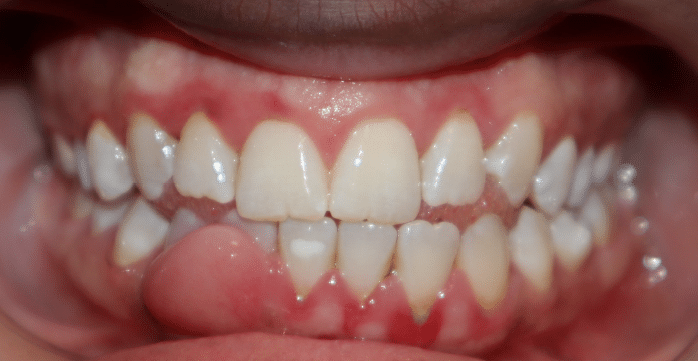
A gingival abscess is a pocket of infection sitting in the gum tissue itself, usually because something got pushed under the gum line and stayed there. A popcorn hull, a piece of shell, a toothbrush bristle. It shows up as a shiny red bump that hurts to touch, it comes on fast, and it is not the same thing as a tooth abscess. Treatment is drainage and cleaning out whatever caused it, and it usually settles within days. Do not wait for it to pop on its own.
Somebody notices a sore bump on the gum, googles it, and lands somewhere that says dental abscess, root canal, possible tooth loss. Then the panic starts.
Sometimes that is the right diagnosis. Often it is not. There are three different things people call a gum abscess, they come from three different places, and the treatment for each one is different. The one confined to the gum tissue is usually the least serious and the fastest to fix.
So it is worth knowing which one you are looking at.
On this page
- What a gingival abscess actually is
- The three kinds, and why the difference matters
- What it looks and feels like
- When it stops being a dental appointment and becomes an emergency
- What treatment involves
- What to do at home in the meantime, and what not to do
- Keeping it from happening again
- Common questions
What a gingival abscess actually is
It is a localized infection in the gum tissue, most often in the little triangle of gum between two teeth. The tooth itself is fine. The nerve inside it is alive and healthy. The problem is entirely in the soft tissue.
It happens because something foreign got forced under the gum edge and the body walled it off. Popcorn hulls are the classic. Fish bones, a fragment of shell, a chip of a chip, and yes, a toothbrush bristle that broke off and worked its way under the gum. Aggressive flossing can do it too, driving debris down rather than sweeping it out.
The onset is fast. People often describe it as fine yesterday, swollen and throbbing today, which is one of the ways it distinguishes itself from the slower problems.
The three kinds, and why the difference matters
This is the part most articles skip, and it is the part that determines what happens next.
| Type | Where it starts | What treatment looks like |
|---|---|---|
| Gingival abscess | In the gum tissue only, from something trapped under the gum edge. Tooth is healthy. | Drain it, clean out the irritant, irrigate. Often resolves in days. No root canal. |
| Periodontal abscess | In a deep gum pocket, in someone who already has gum disease and bone loss. | Drain and debride the pocket, then treat the underlying periodontitis. Often needs deeper gum treatment. |
| Periapical abscess | Inside the tooth, from deep decay or a crack that let bacteria reach the nerve. Infection exits at the root tip. | A root canal or an extraction. Draining it alone does not fix the cause. |
The quick tell: a gingival abscess sits high on the gum near the edge and the tooth beside it feels normal. A periapical abscess usually comes with a tooth that aches, throbs, or hurts to bite on, and the bump tends to sit lower, toward the root tip.
What it looks and feels like
Red and shiny, sometimes almost purple. Swollen enough to change the shape of the gum between the teeth. Tender to touch and often to brushing. Some people get a bad taste, which usually means it has started draining on its own.
What you generally do not get with a purely gingival abscess is a sick feeling. No fever, no swollen face, no swollen lymph nodes. If any of those show up, the picture has changed and so has the urgency.
When it stops being a dental appointment and becomes an emergency
Most of the time this is a same week problem, not a middle of the night one. These are the exceptions.
Go now, meaning an emergency room and not a dental office, if there is swelling spreading into the face or under the jaw, if you have trouble swallowing or breathing, if the swelling is closing an eye, or if you have a fever with any of that. Infections in the floor of the mouth can move fast and compromise the airway. That is rare, and it is the reason the rule exists.
Short of that, call a dentist and get seen. An emergency dental visit handles the actual cause. We wrote about what an emergency room can and cannot do for a tooth, because the answer surprises people: they can treat the infection and the pain, but almost none of them can treat the tooth.
Facial swelling, trouble swallowing, or fever changes this from a dental problem to a medical one. Everything below that line is a phone call in the morning.
What treatment involves
Less than people expect. The abscess gets drained, the area under the gum gets irrigated and cleaned out, and whatever was trapped in there comes out with it. That is usually the whole appointment.
Antibiotics often are not necessary. An abscess is a walled off collection of pus, and antibiotics do not penetrate it well. Draining it is what resolves it. Antibiotics get added when the infection has spread beyond the local site or when someone medically needs the coverage, not as a default.
Relief is generally quick once the pressure is released. If the underlying issue turns out to be a deep pocket or a dying nerve rather than a trapped popcorn hull, the plan changes accordingly, which is why the diagnosis matters more than the drainage.
What to do at home in the meantime, and what not to do
Warm salt water rinses, several times a day. A half teaspoon in a cup of warm water. It will not cure it, but it keeps the area clean and takes some of the pressure off if it is draining.
Keep brushing, gently, including the sore area. People stop cleaning around it, which makes the inflammation worse.
Over the counter anti inflammatory medication for the pain, assuming you can take it.
Now the do nots. Do not try to lance it with anything. Do not put aspirin against the gum, which burns the tissue and does nothing for the infection. Do not poke at it with a pick to release it. And do not sit on it hoping it resolves. It might quiet down and come back, and the version that keeps coming back is usually the one that was never a simple gingival abscess to begin with.
The American Dental Association makes the same basic point about all of them. The symptoms overlap enough that guessing at home is not reliable.
Keeping it from happening again
If it was a one time popcorn hull, there is not much to prevent. It happens to people with excellent hygiene.
If it keeps happening in the same spot, that is worth investigating. Repeat abscesses in one area usually mean there is a place where food packs in, which points to a gap, a rough filling margin, a contact between two teeth that opened up, or early gum disease creating a pocket that traps things.
That is a fixable problem, but it gets fixed by finding the trap, not by draining the abscess a third time.
Common questions
Is a gingival abscess the same as a tooth abscess?
No. A gingival abscess sits in the gum tissue and the tooth beside it is healthy. A tooth abscess, properly a periapical abscess, starts inside the tooth from decay or a crack and generally requires a root canal or extraction.
Will a gum abscess go away on its own?
It may drain and quiet down, which feels like it went away. The cause is usually still there, so it tends to come back. Getting it drained and cleaned properly is what ends it.
Do I need antibiotics for a gum abscess?
Often not. Antibiotics do not penetrate a walled off pocket of pus well, so drainage is the treatment. They get added when the infection has spread beyond the local area or when your medical history calls for it.
Can I pop a gum abscess myself?
No. You will not clear what caused it, you risk pushing the infection deeper, and anything you use is not sterile. Warm salt water rinses until you can be seen.
How fast can I be seen for this?
Call the same day. Most offices hold time for this kind of thing, and it is usually a short appointment. We are open Monday through Friday, 8:00 AM to 5:00 PM at (469) 598-1021.
When should I go to an emergency room instead?
If swelling is spreading into your face or under your jaw, if you are having trouble swallowing or breathing, if an eye is swelling shut, or if you have a fever along with any of that. Those signs mean the infection is no longer local.
A sore gum bump is a same day call
We hold time for this. Most of the time it is a short appointment, the pressure comes off immediately, and you leave knowing whether it was a trapped popcorn hull or something that needs a longer look.
You may also be interested in these
- Why is your face swelling up? When it is an emergency
- Do emergency rooms have dentists?
- Can you cure gum disease without a dentist?
About Tribute Family Dentistry
200+ five-star Google reviews • Family owned and independent • D Magazine Best Dentist 2026 • Living Magazine Readers' Choice 2026 • Se habla espanol
Tribute is a family owned, independent family dentist in Frisco, on FM 423. I own it with my wife, Dr. Julia Kang, DMD. We both trained at Boston University and we are both members of the Omicron Kappa Upsilon national honor society. I am a Diplomate of the American Board of Orthodontics. Day to day, most patients and their kids see Dr. Christina Pham, DMD, our general and family dentist, and wisdom teeth removal is handled by Dr. David Roberts, DDS. D Magazine named me a Best Dentist for 2026, and Living Magazine readers voted us Best Family Dentist in Frisco and Plano the same year.
We handle the whole family in one place: cleanings and preventive care, fillings, crowns, bridges, implants, root canals, extractions and wisdom teeth, whitening, night guards, and emergency visits. We are open Monday through Friday, 8:00 AM to 5:00 PM, we speak Spanish, we work with most major insurance plans, and we run an in house savings plan for families without dental benefits.
If you need braces or clear aligners, that is the other side of what we do. Elate Orthodontics, our sister practice, treats kids, teens, and adults out of three offices in Frisco and The Colony.
Tribute Family Dentistry
5605 FM 423, Suite 600-B, Frisco, TX 75036
Book an appointment: (469) 598-1021
About the author: Dr. Kevin Baharvand, DMD, MS is a Diplomate of the American Board of Orthodontics and a national speaker on clear aligner treatment. His clinical work was selected for the cover of the American Journal of Orthodontics and Dentofacial Orthopedics. He and his wife, Dr. Julia Kang, own Tribute Family Dentistry and Elate Orthodontics in Frisco, Texas.
