


8 min read • By Dr. Kevin Baharvand, DMD, MS • Updated August 2026
The short answer
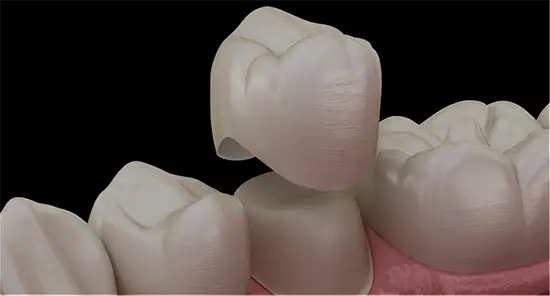
A crown is a custom cap that covers a tooth completely, replacing its outer shape and taking the chewing load off what is left underneath. You need one when there is not enough solid tooth left to hold a filling, when a tooth is cracked, or after a root canal. The choice of material matters more than most people are told, and so does the sequencing: whiten before, not after, and get the crown placed promptly once a root canal is done.
A filling replaces part of a tooth. A crown replaces the outside of the whole tooth.
That is the actual distinction, and it explains why a dentist recommends one over the other. It is not about severity in the abstract. It is about how much solid structure is left to hold something in place.
A tooth that is mostly filling material with thin walls around it will eventually split, usually while eating something unremarkable. A crown wraps it and takes the load off those walls.
On this page
When a crown is the right answer
Five common situations, and one where it usually is not.
A tooth with a large existing filling that keeps failing, where each replacement removes a bit more structure. At some point rebuilding it again is treating the symptom.
A cracked tooth. Cracks propagate under chewing force. A crown holds the tooth together and stops the crack from running further down the root, which is the point where the tooth is no longer savable.
After a root canal on a back tooth. The tooth has been hollowed out and is brittle, and molars take the most force in the mouth.
A tooth broken to the point where there is not enough left above the gum for a filling to grip.
On top of a dental implant, where the crown is the visible tooth part of the assembly.
Where it usually is not the answer: a small to moderate cavity in an otherwise solid tooth. That is a filling. If a crown is being proposed for something small, it is fair to ask why, and to ask to see the image.
The materials, and why it matters
This is the part of the conversation that usually gets skipped, and the difference is real.
| Material | Best for | Trade off |
|---|---|---|
| Zirconia | Back teeth, heavy grinders | Extremely strong and hard to chip. Slightly less lifelike than porcelain, though modern versions are close |
| Porcelain fused to metal | Long span bridges, older approach | Strong, but a dark metal line can show at the gum line as gums recede |
| All porcelain or lithium disilicate | Front teeth, anywhere appearance matters | The best aesthetics. Somewhat less fracture resistant than zirconia under heavy load |
| Gold | Back teeth, longevity above all | Outlasts nearly everything and is gentle on the opposing tooth. Nobody wants it visible |
| Same visit milled ceramic | Convenience, one appointment | No temporary and no second visit. Material choice is limited to what the mill supports |
If you grind your teeth, say so before the material is chosen. A porcelain crown placed in a mouth that grinds without a night guard to protect it is a crown with a short and expensive future.
What actually happens
Two visits, in the traditional approach.
First visit: the tooth is numbed and shaped, meaning enough of the outer surface is reduced to make room for the crown to sit without being bulky. An impression or a digital scan captures the shape, the bite, and the neighbouring teeth. A temporary crown goes on and you leave.
Between visits, a lab manufactures it. This is a person making a custom object, which is why lab quality shows up in the fit and in how it looks.
Second visit, typically two to three weeks later: the temporary comes off, the permanent crown is tried in, the fit and bite and colour are checked, and it is cemented.
Same visit options exist, where the crown is designed and milled in the office in a couple of hours. The convenience is genuine. The material range is narrower.
The temporary is the part people underestimate
A temporary crown is not built to last. It is built to protect the tooth and hold the space for a few weeks.
Avoid sticky food on that side, be careful flossing around it by pulling the floss out sideways rather than up, and if it comes off, call. Do not leave it off. The neighbouring teeth drift within days and the permanent crown may then not seat properly, which means remaking it.
The bigger version of this is a tooth left in a temporary for months after a root canal. The temporary leaks, bacteria repopulate the canal system, and the root canal fails for reasons unrelated to the root canal. We went through that in detail in should a dentist pay for a failed root canal.
A root canal is not finished until the crown is on it. Anything that stretches that gap into months is putting the whole treatment at risk.
Living with it
Some sensitivity for a week or two is normal, particularly to cold, and particularly if the tooth was already inflamed.
A crown that feels high needs adjusting, and this takes two minutes. Do not tolerate it. All your chewing force landing on one tooth causes soreness that will not resolve on its own.
You still get decay at the margin where the crown meets the tooth. The crown itself cannot decay, but the tooth underneath absolutely can, and that margin is the most common place a crowned tooth eventually fails. Floss it like any other tooth.
With reasonable care, expect somewhere in the range of ten to fifteen years, often longer. Grinding, decay at the margin, and how much healthy tooth was left underneath in the first place are what determine which end of that range you land on.
Two sequencing rules worth knowing
Whiten first. Crowns and other restorations do not change shade when you whiten, so a crown matched to your current colour will stand out later if you brighten your teeth afterward. Whiten, wait about two weeks, then match the crown.
Orthodontics before crowns, not after. A crown is built to fit a tooth in a specific position and to contact the teeth beside it a specific way. Move the teeth afterward and those relationships change. If braces or aligners are anywhere on your horizon, sort out the order first, which we covered in can you get braces with a crown.
Common questions
What is the difference between a filling and a crown?
A filling replaces part of a tooth. A crown covers the whole tooth and takes the chewing load off what remains. The deciding factor is how much solid structure is left.
Do I really need a crown after a root canal?
On back teeth, almost always. The tooth is hollowed out and brittle, and molars take the heaviest force. Front teeth are sometimes an exception depending on how much structure remains.
How long does a dental crown last?
Commonly ten to fifteen years and often longer. Grinding, decay at the margin where crown meets tooth, and how much healthy tooth was left underneath determine the range.
Which crown material is best?
It depends on the tooth. Zirconia for strength on back teeth, all porcelain for appearance on front teeth, gold for outright longevity where looks do not matter. Tell your dentist if you grind.
Can a crown get a cavity?
The crown cannot, but the tooth underneath can, especially at the margin where they meet. That is the most common reason a crowned tooth eventually needs more work.
Should I whiten my teeth before or after a crown?
Before. Crowns do not change shade with whitening, so match the crown to your teeth after you have reached the colour you want.
Told you need a crown and want a second look?
Bring your x-rays or have them sent over. We will show you on the screen what is actually going on with the tooth, and tell you plainly whether it is a crown situation or a filling situation.
You may also be interested in these
- Should a dentist pay for a failed root canal?
- Can you get braces with a crown?
- How long does numbness last after a filling?
About Tribute Family Dentistry
200+ five-star Google reviews • Family owned and independent • D Magazine Best Dentist 2026 • Living Magazine Readers' Choice 2026 • Se habla espanol
Tribute Family Dentistry is a family owned, independent practice on FM 423 in Frisco. I own it with my wife, Dr. Julia Kang, DMD. We both trained at Boston University and we are both members of the Omicron Kappa Upsilon national honor society. I am a Diplomate of the American Board of Orthodontics. Day to day, most patients and their kids see Dr. Christina Pham, DMD, our general and family dentist, and wisdom teeth removal is handled by Dr. David Roberts, DDS. D Magazine named me a Best Dentist for 2026, and Living Magazine readers voted us Best Family Dentist in Frisco and Plano the same year.
We handle the whole family in one place: cleanings and preventive care, fillings, crowns, bridges, implants, root canals, extractions and wisdom teeth, whitening, night guards, and emergency visits. We are open Monday through Friday, 8:00 AM to 5:00 PM, we speak Spanish, we work with most major insurance plans, and we run an in house savings plan for families without dental benefits.
If you need braces or clear aligners, that is the other side of what we do. Elate Orthodontics, our sister practice, treats kids, teens, and adults out of three offices in Frisco and The Colony.
Tribute Family Dentistry
5605 FM 423, Suite 600-B, Frisco, TX 75036
Book an appointment: (469) 598-1021
About the author: Dr. Kevin Baharvand, DMD, MS is a Diplomate of the American Board of Orthodontics and a national speaker on clear aligner treatment. His clinical work was selected for the cover of the American Journal of Orthodontics and Dentofacial Orthopedics. He and his wife, Dr. Julia Kang, own Tribute Family Dentistry and Elate Orthodontics in Frisco, Texas.
