


8 min read • By Dr. Kevin Baharvand, DMD, MS • Updated August 2026
The short answer
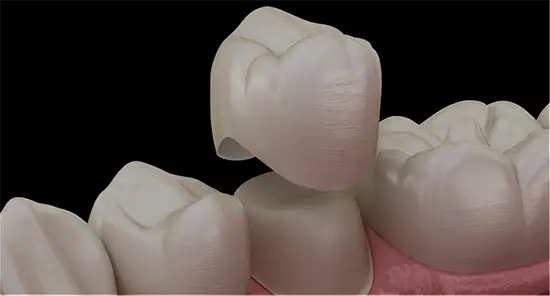
Yes. A crown does not stop you from having braces. What changes is the details: a bracket does not bond to porcelain the way it bonds to enamel, so it needs different surface preparation and it comes loose more often. Implants are the real exception, because an implant is fused to bone and cannot be moved at all. And the sequence matters more than people expect. Orthodontics should generally come before new crowns and veneers, not after.
This question comes up constantly with adult patients, and it is usually asked with an apology attached, as though having dental work already done disqualifies you.
It does not. A large share of adult orthodontic patients have crowns, veneers, implants, or bridges somewhere in their mouth. It is entirely routine.
What it does mean is that the plan needs to account for them, and that a few things need to happen in a specific order.
On this page
Why a crown changes the bracket, not the treatment
A bracket sticks to a natural tooth through a bond to enamel, which is a rough, porous, mineral surface. That bond is strong and predictable.
Porcelain is smooth and glassy. Bonding to it requires preparing the surface first, usually by roughening it and applying a primer that gives the adhesive something to grab. Done properly, it holds. Done casually, the bracket pops off in week three, and then again in week seven.
So the practical difference is reliability rather than possibility. Brackets on crowns fail more often than brackets on enamel, and any orthodontist who has treated adults expects that and plans around it.
There are alternatives. On a molar with a full crown, a band cemented around the tooth is often more reliable than a bonded bracket. And in some cases a crowned tooth does not need a bracket at all, because it is not one of the teeth that has to move.
What each kind of restoration means for treatment
They are not equivalent, and the differences matter at the planning stage.
| What you have | Can you have braces | What changes |
|---|---|---|
| A single crown | Yes | Surface preparation for bonding, or a band instead. Expect the occasional loose bracket |
| Multiple crowns or veneers | Yes | Same bonding issue on each. Worth discussing whether old restorations get replaced afterward anyway |
| A dental implant | Yes, but the implant will not move | An implant is fused to bone. It can serve as an anchor to pull other teeth against, but it cannot be repositioned |
| A fixed bridge | Yes, with planning | A bridge splints teeth together so they cannot move independently. It often has to be sectioned or replaced during treatment |
| A large filling or a root canal treated tooth | Yes | Root canal treated teeth move normally. They can be slightly more brittle, so forces are kept sensible |
| Clear aligners with crowns or veneers | Yes, often simpler | No brackets to bond, though attachments still bond to the tooth surface and have the same porcelain issue |
The implant is the one real limitation
This is the part worth understanding properly, because it drives the whole sequence.
A natural tooth sits in bone attached by a ligament. That ligament is what lets orthodontics work: apply gentle sustained pressure and the bone remodels around the tooth, and it moves.
An implant has no ligament. It is fused directly to the bone. Apply orthodontic force to it and nothing happens, which is occasionally useful, because it makes an excellent anchor to move other teeth against. But the implant itself stays exactly where it was placed, forever.
Which is why placing an implant before orthodontic treatment can be a costly mistake. If the plan involves closing spaces or changing the alignment of the arch, an implant already placed in the old position may end up in the wrong place, and the fix is not simple.
If anyone is discussing both implants and orthodontics with you, get those two conversations in the same room before either one starts.
Implants do not move. Place one before orthodontic treatment and you have permanently decided where that tooth lives.
The sequence almost always runs one direction
Orthodontics first. Final cosmetic and restorative work second.
The reasoning is straightforward. A crown or veneer is built to fit a tooth in a specific position, contacting the teeth beside it in a specific way, meeting the opposing tooth at a specific point. Move that tooth afterward and all three of those relationships change.
It is also more economical. If your front teeth are crowded and you want them to look better, straightening them first often means the veneers you thought you needed turn out to be smaller, fewer, or unnecessary. Teeth that are aligned require far less porcelain to look good than teeth that are being cosmetically camouflaged into a straight appearance.
I have seen the other order too many times: an expensive set of veneers placed on crowded teeth, then orthodontics a few years later, then the veneers replaced. That is paying twice for the same result.
Would clear aligners be easier?
Often, yes, for exactly the reason you would expect. Aligners are trays. They do not need to bond to anything to apply pressure, so a mouth full of porcelain is less of a complication.
The caveat is attachments. Most aligner treatment uses small tooth colored bumps bonded to certain teeth to give the tray something to grip, and those attachments bond to the tooth surface with the same porcelain limitation as a bracket.
On effectiveness, aligners have come a long way and the published evidence supports them for a wide range of cases, though not every case. Which system and which approach fits depends on what actually needs to move, and that is a conversation with an orthodontist rather than a decision to make from an article.
One thing to expect afterward
If your crowns are old, budget for the possibility of replacing some of them after treatment.
This is not upselling. When teeth move, the contacts between them change and the way they meet the opposing arch changes. A crown that fit well in the old position may not fit as well in the new one, and an old crown with a marginally leaking edge is worth replacing anyway once everything is settled.
Discuss it before you start so it is in the plan and not a surprise at the end.
If you are considering orthodontic treatment, that is what our sister practice does. Elate Orthodontics handles braces and clear aligners for adults and teens, and since we own both, your general dentist and your orthodontist are actually talking to each other about the sequence.
Common questions
Can you put braces on a crown?
Yes. The bracket bonds to porcelain rather than enamel, which requires different surface preparation and holds less reliably, so loose brackets are more common. A band around the tooth is an alternative on molars.
Can you move an implant with braces?
No. An implant is fused to the bone with no periodontal ligament, so it cannot be repositioned. It can be used as an anchor to move other teeth.
Should I get veneers before or after braces?
After, in almost every case. Veneers are built for a tooth in a specific position, and straightening first often means you need less porcelain, or none.
Do I need to replace my crowns after orthodontic treatment?
Sometimes. Moving teeth changes how they contact each other and the opposing arch. Old crowns with worn margins are often worth replacing once everything has settled.
Can I have braces with a dental bridge?
Usually yes, with planning. A fixed bridge splints those teeth together so they cannot move independently, so it may need to be sectioned or replaced during treatment.
Are clear aligners better than braces if I have a lot of dental work?
Often simpler, since there are no brackets to bond to porcelain. Attachments still bond to the tooth surface, so the limitation does not disappear entirely.
Crowns, implants, and a plan that fits together
We handle general and restorative dentistry here, and our sister practice handles the orthodontics. If both are on the table, get them planned in the right order before anything gets started.
You may also be interested in these
About Tribute Family Dentistry
200+ five-star Google reviews • Family owned and independent • D Magazine Best Dentist 2026 • Living Magazine Readers' Choice 2026 • Se habla espanol
Tribute is a family owned, independent dental practice on FM 423 in Frisco. I own it with my wife, Dr. Julia Kang, DMD. We both trained at Boston University and we are both members of the Omicron Kappa Upsilon national honor society. I am a Diplomate of the American Board of Orthodontics. Day to day, most patients and their kids see Dr. Christina Pham, DMD, our general and family dentist, and wisdom teeth removal is handled by Dr. David Roberts, DDS. D Magazine named me a Best Dentist for 2026, and Living Magazine readers voted us Best Family Dentist in Frisco and Plano the same year.
We handle the whole family in one place: cleanings and preventive care, fillings, crowns, bridges, implants, root canals, extractions and wisdom teeth, whitening, night guards, and emergency visits. We are open Monday through Friday, 8:00 AM to 5:00 PM, we speak Spanish, we work with most major insurance plans, and we run an in house savings plan for families without dental benefits.
If you need braces or clear aligners, that is the other side of what we do. Elate Orthodontics, our sister practice, treats kids, teens, and adults out of three offices in Frisco and The Colony.
Tribute Family Dentistry
5605 FM 423, Suite 600-B, Frisco, TX 75036
Book an appointment: (469) 598-1021
About the author: Dr. Kevin Baharvand, DMD, MS is a Diplomate of the American Board of Orthodontics and a national speaker on clear aligner treatment. His clinical work was selected for the cover of the American Journal of Orthodontics and Dentofacial Orthopedics. He and his wife, Dr. Julia Kang, own Tribute Family Dentistry and Elate Orthodontics in Frisco, Texas.
