

8 min read • By Dr. Kevin Baharvand, DMD, MS • Updated August 2026
The short answer
Any fluoride toothpaste, used properly, beats an expensive one used badly. What matters in braces is fluoride first, low abrasivity second, and technique third. Skip whitening toothpaste entirely while brackets are on, because you cannot whiten the enamel underneath a bracket and you will end up with pale squares when they come off. The genuine risk during treatment is not stained teeth. It is white spot lesions, which are permanent.
I am an orthodontist, so I have watched a lot of teenagers go through this, and the toothpaste is rarely the variable that decides how their teeth look at the end.
What decides it is whether the area right around each bracket gets cleaned every single day for two years. Brackets create a shelf that traps plaque, and the enamel immediately around them is where the damage shows up.
That said, some choices help and one common choice actively causes a problem. So here is the short version of what to buy and, more usefully, what to do with it.
On this page
What actually matters in a toothpaste during treatment
Fluoride, and enough of it. This is the entire point. Standard toothpaste is around 1,350 to 1,500 parts per million fluoride, and that is fine for most people. For patients at higher risk, and a lot of braces patients are, orthodontists frequently prescribe a high fluoride paste at 5,000 ppm for nightly use. If your orthodontist has offered one, take it. That single change does more than any other product decision.
Low abrasivity. Brackets and wires are already hard on the enamel around them, and an abrasive paste adds wear on surfaces already under stress. This rules out most whitening formulas and all charcoal ones, for the reasons in the charcoal toothpaste piece.
A flavour they will actually use twice a day. This sounds trivial and is not. A fourteen year old who hates the taste brushes for forty seconds.
That is the whole list. Everything else on the packaging is marketing.
Why not whitening toothpaste, specifically
This one deserves its own section because it comes up constantly and the consequence is visible.
The enamel under a bracket is covered for the length of treatment. Nothing applied to the outside of the tooth reaches it. So any whitening effect happens only on the exposed enamel around the bracket.
Take the brackets off two years later and you have squares of unaffected enamel surrounded by lighter enamel. It is subtle with mildly abrasive pastes and unmistakable with peroxide whitening strips, which is why no orthodontist will let you use strips during treatment.
The correct order is: finish treatment, get the brackets off, have a professional cleaning, wait a couple of weeks, then whiten the whole tooth surface evenly. It is worth the wait.
You cannot whiten enamel that is underneath a bracket. Whitening during treatment does not produce whiter teeth, it produces a pattern.
The real risk, which is not staining
White spot lesions. These are chalky white marks that appear around where brackets were, and they are the thing I would want every braces patient to know about on day one.
They are not stains. They are early decay, specifically demineralised enamel, caused by plaque sitting against the tooth surface for extended periods. They form around the bracket edges because that is where plaque accumulates and where a toothbrush most often misses.
They are largely permanent. Some improve slightly with fluoride and remineralisation over time, and some can be treated with resin infiltration or masked cosmetically, but they do not simply disappear. A patient can finish treatment with beautifully straight teeth and permanent white marks on them, and that is a genuinely disappointing outcome after two years.
They are also almost entirely preventable with fluoride and consistent cleaning around the brackets. That is why orthodontists sound repetitive about hygiene. It is not fussiness, it is the one lasting harm the appliance can cause.
The kit that actually helps
More useful than any toothpaste comparison.
| Item | Why | How often |
|---|---|---|
| Fluoride toothpaste, or 5,000 ppm if prescribed | The active ingredient preventing white spots | Twice daily, prescription paste at night |
| Interdental or interproximal brush | Gets under the wire and around each bracket. The highest value tool in the kit | Daily |
| Floss threaders or orthodontic floss | Reaches the contact between teeth, which brushes cannot | Daily |
| Water flosser | Flushes around brackets in seconds. Worth it for compliance alone | Daily |
| Orthodontic wax | For a bracket or wire rubbing the lip | As needed |
| Fluoride mouth rinse | Extra protection, especially for less reliable brushers | Nightly |
| Custom mouthguard, for contact sports | Protects the lips from the brackets on impact | Every practice and game |
The interdental brush is the item that changes outcomes most and the one most likely to be sitting unused in a drawer. Thirty seconds a day with one of those does more than any upgrade in toothpaste.
Technique, since it matters more than the product
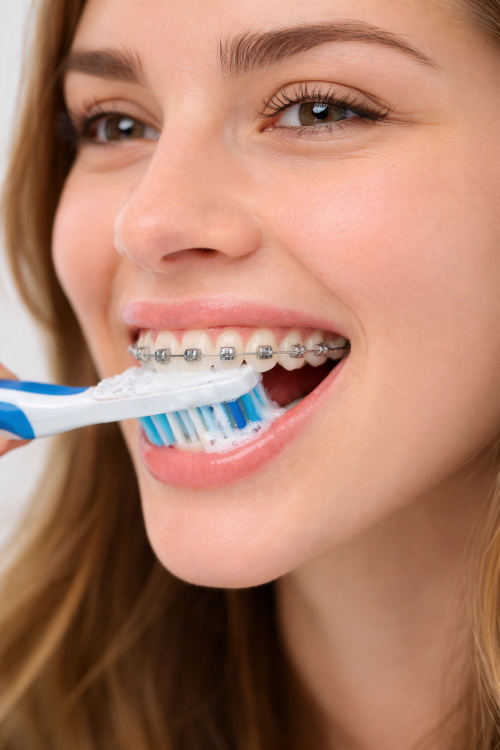
Angle the brush at the bracket, not at the tooth. Come in from above the bracket pointing down, then from below pointing up. That is where the plaque collects and where a straight on brushing motion glides right past.
Two minutes minimum, and it genuinely takes longer with braces than without. Four minutes is not unreasonable.
Brush after meals when possible, because food packs into the appliance and sits there. If brushing is not possible, rinse vigorously with water.
Avoid the obvious offenders. Sticky sweets, hard candy, ice, popcorn, and anything that will snap a bracket off and cost you an extra appointment. Sugary drinks matter more than usual in braces because the sugar sits around the brackets for hours.
If you are in aligners instead
Different problem entirely, and in some ways easier.
You take them out to eat and brush normally, so there is no bracket to clean around and white spot lesions are far less of a concern. That is one of the genuine clinical advantages of aligners over brackets.
What matters instead is the trays themselves. Rinse them every time you take them out, brush them gently with mild soap rather than toothpaste, which scratches them, and never clean them in hot water because they warp. The principles are the same as for a night guard.
And brush before putting them back in. Sealing sugar against your teeth under a tray for twenty two hours is the one way aligners create a decay risk that braces do not.
If you are weighing braces against aligners, that is a conversation for our sister practice, Elate Orthodontics, rather than something to decide from a toothpaste article.
Common questions
What is the best toothpaste for braces?
Any fluoride toothpaste used properly. If your orthodontist offers a prescription 5,000 ppm fluoride paste for nightly use, that is the single most useful upgrade.
Can I use whitening toothpaste with braces?
No. The enamel under each bracket is shielded, so whitening only affects the exposed surface and leaves visible squares when the brackets come off. Whiten after treatment instead.
What are the white marks around my brackets?
White spot lesions, which are early decay from plaque sitting against the enamel. They are largely permanent, which is why cleaning around brackets matters so much.
Is charcoal toothpaste bad with braces?
Yes, avoid it. It is abrasive, most versions contain no fluoride, and fluoride is the main thing protecting enamel during treatment.
What is the most useful cleaning tool with braces?
An interdental brush that fits under the wire and around each bracket. It reaches what a normal toothbrush glides past.
Do I need special toothpaste for clear aligners?
No. Brush normally before putting the trays back in. Clean the trays themselves with mild soap and cool water, never toothpaste or hot water.
In braces and not sure it is going well?
Come in for a cleaning during treatment rather than waiting until the brackets come off. We can see early demineralisation long before it is visible to you, and at that stage it is still something we can work with.
You may also be interested in these
About Tribute Family Dentistry
200+ five-star Google reviews • Family owned and independent • D Magazine Best Dentist 2026 • Living Magazine Readers' Choice 2026 • Se habla espanol
Tribute Family Dentistry is a family owned, independent practice on FM 423 in Frisco. I own it with my wife, Dr. Julia Kang, DMD. We both trained at Boston University and we are both members of the Omicron Kappa Upsilon national honor society. I am a Diplomate of the American Board of Orthodontics. Day to day, most patients and their kids see Dr. Christina Pham, DMD, our general and family dentist, and wisdom teeth removal is handled by Dr. David Roberts, DDS. D Magazine named me a Best Dentist for 2026, and Living Magazine readers voted us Best Family Dentist in Frisco and Plano the same year.
We handle the whole family in one place: cleanings and preventive care, fillings, crowns, bridges, implants, root canals, extractions and wisdom teeth, whitening, night guards, and emergency visits. We are open Monday through Friday, 8:00 AM to 5:00 PM, we speak Spanish, we work with most major insurance plans, and we run an in house savings plan for families without dental benefits.
If you need braces or clear aligners, that is the other side of what we do. Elate Orthodontics, our sister practice, treats kids, teens, and adults out of three offices in Frisco and The Colony.
Tribute Family Dentistry
5605 FM 423, Suite 600-B, Frisco, TX 75036
Book an appointment: (469) 598-1021
About the author: Dr. Kevin Baharvand, DMD, MS is a Diplomate of the American Board of Orthodontics and a national speaker on clear aligner treatment. His clinical work was selected for the cover of the American Journal of Orthodontics and Dentofacial Orthopedics. He and his wife, Dr. Julia Kang, own Tribute Family Dentistry and Elate Orthodontics in Frisco, Texas.
