


10 min read • By Dr. Kevin Baharvand, DMD, MS • Updated August 2026
The short answer
A deep cleaning, properly called scaling and root planing, removes hardened deposits from below the gum line and smooths the root surface so the tissue can reattach. It is a treatment for gum disease, not a more thorough version of a regular cleaning. You get numbed, it is usually split across two visits, and afterwards your gums shrink somewhat as the inflammation resolves, which nobody warns people about. If you are unsure whether you actually need one, ask to see your pocket measurements and your x-rays. That is the evidence, and you are entitled to look at it.
Somebody goes in for a routine cleaning and comes out with a treatment plan for a deep cleaning, four figures, split into quadrants. The reaction is almost always the same, and it is a reasonable one: is this real, or is this a sales pitch?
The answer is that it is a real procedure, it is genuinely necessary when it is necessary, and it is also over recommended in some offices and under recommended in others. Both of those things are true at once.
So rather than telling you to trust your dentist, here is what it actually is, and what evidence you can ask to see.
On this page
What it actually is
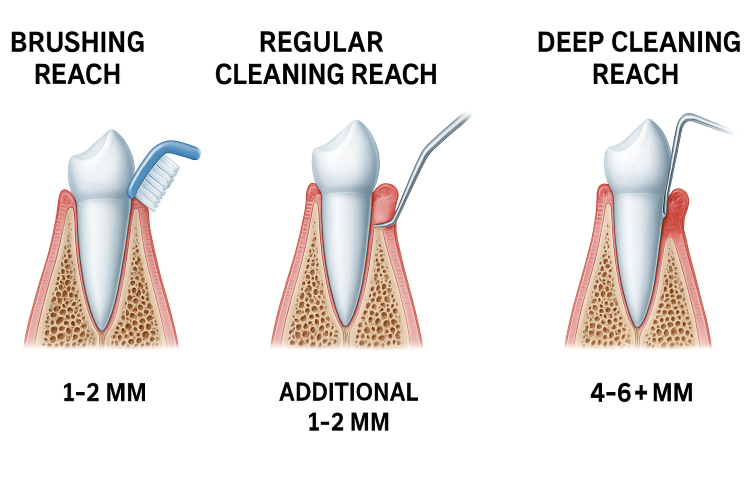
A regular cleaning, technically a prophylaxis, cleans the tooth surfaces at and slightly above the gum line. It is preventive. It is for a mouth that is healthy or close to it.
Scaling and root planing goes below the gum line, into the pocket that has formed between the gum and the root. Two parts to it, and the names are literal.
Scaling is removing the hardened deposits, the tartar, from the root surface down inside that pocket. Ultrasonic instruments do most of the work now, with hand instruments for the detail.
Root planing is smoothing the root surface afterward. This part matters more than people realise. A rough, contaminated root surface is where bacteria colonise and it is a surface the gum tissue cannot reattach to. Smoothing it gives the tissue a chance to reattach and shrinks the pocket.
That is why it is a treatment rather than a cleaning. You are changing the anatomy of the pocket so it can heal.
How to tell whether you actually need one
Two pieces of evidence, and both of them are objective.
Pocket depths. The hygienist measures around every tooth with a small probe and calls out numbers. One to three millimetres is healthy. Four is borderline. Five and above with bleeding is a pocket that will not stay clean no matter how well you brush, because a toothbrush bristle does not reach five millimetres below the gum.
Bone levels on x-ray. Gum disease destroys the bone supporting the tooth, and that shows on an x-ray as the bone level having dropped away from where it should sit. This is the part that distinguishes gingivitis from periodontitis, and it is not a judgement call.
Ask to see both. A legitimate recommendation is easy to show you: here is the chart with numbers over four, here are the bleeding points, here on the x-ray is where the bone used to be. If the answer is vague, or if it is a general statement about your gums looking inflamed without measurements to back it, ask more questions.
The particular thing to be sceptical about is a deep cleaning recommended for a full mouth of threes with no bleeding and no bone loss on x-ray. That is a mouth that needs a regular cleaning and better flossing.
| Regular cleaning | Deep cleaning | Maintenance | |
|---|---|---|---|
| What it treats | Healthy gums or gingivitis | Periodontitis with pockets and bone loss | Periodontitis after treatment |
| How far it goes | At and just above the gum line | Below the gum line, into the pocket, onto the root | Below the gum line, ongoing |
| Numbing | No | Usually yes | Sometimes |
| Visits | One | Usually two, split by side or quadrant | One, more frequently |
| How often | Every six months | Once, then reassess | Every three to four months |
| Billed as | Preventive, often fully covered | Basic or major, often per quadrant | Separate code, coverage varies |
Ask to see the pocket chart and the x-rays. Real gum disease is easy to show a patient. If nobody will show you, that itself is the answer.
What the appointment is actually like
Better than the name suggests, and worse than a regular cleaning.
You get numbed, usually one side or one quadrant at a time, which is why it typically takes two visits. Doing the whole mouth at once means the entire mouth is numb, which most people find unpleasant and which makes the appointment very long.
Then it is ultrasonic scaling, which is vibration and water, followed by hand instruments to check and refine. Expect pressure and vibration rather than pain. Ninety minutes per side is common.
Some offices add an antibiotic gel placed into deeper pockets, or a course of a systemic antibiotic. Neither is universally needed. It is fair to ask what a specific addition is for and what it adds to the cost.
The word deep does not refer to how hard they scrub. It refers to how far below the gum line the instruments reach.
What happens afterward, including the part nobody mentions
Soreness for a few days, manageable with anti inflammatory medication. Sensitivity to cold, sometimes for several weeks. Both are normal.
Here is the part people are rarely warned about, and it causes real distress when it is a surprise. As the inflammation resolves, your gums shrink. They were swollen, and swollen tissue takes up space. Once they settle down, teeth can look slightly longer, and small dark triangles can appear between them where puffy tissue used to fill the gap.
That is not damage. It is what the actual state of your gums looks like without inflammation hiding it. But it changes how your smile looks, particularly at the front, and being told beforehand makes an enormous difference to how people feel about it.
You may also notice a tooth feels slightly more sensitive to touch for a while as the tissue reattaches. That settles.
What should not happen: increasing pain after the first few days, swelling, or a bad taste. Those warrant a call.
What comes after the treatment
This is where a lot of the value is either captured or lost.
A re evaluation appointment, typically four to six weeks later, where the pockets are measured again. That number is the score. Pockets that were sixes and are now threes mean it worked. Pockets that have not changed mean something else is going on, whether that is a spot that could not be reached, ongoing smoking, or uncontrolled diabetes.
Then maintenance, usually every three to four months rather than every six. This is not an upsell. Pockets that have been treated recolonise faster than healthy tissue does, and the three month interval is what the evidence supports for keeping them stable.
And home care that goes beyond brushing. Interdental brushes are more effective than floss for anyone with existing pockets, and a water flosser helps reach below the gum line in a way floss does not. What you cannot do at home is remove tartar, which is why home care alone does not resolve periodontitis.
The cost and insurance side
Scaling and root planing is billed per quadrant, so a full mouth is four units. That is why the number on the estimate looks large compared to a cleaning.
Most dental plans cover it under basic or major services, commonly around eighty or fifty percent, and most require documentation before they will pay: pocket charting and current x-rays showing bone loss. If those do not support the diagnosis, the claim gets denied, which is another reason a legitimate recommendation comes with measurable evidence attached.
Plans also limit how often it can be repeated on the same area, often once every two or three years.
Get the estimate in writing with the codes and your portion before you schedule, and if the whole mouth is recommended, it is reasonable to ask whether it can be sequenced across a benefit year boundary. We went through how that works in the Delta Dental guide, and the same logic applies to most carriers.
And if the answer is that you cannot afford all of it right now, say so rather than declining. Treating the worst quadrants first is a legitimate plan.
What happens if you skip it
Nothing, for a while. That is the difficulty with gum disease. It is largely painless, it progresses slowly, and nothing dramatic happens for years.
What does happen is continued bone loss. Bone is what holds teeth in. Enough of it goes and teeth loosen, shift, and are eventually lost, and by that stage the options are extraction and replacement rather than treatment.
Gum disease is the leading cause of adult tooth loss, ahead of decay. It gets ignored because it does not hurt, and it does not hurt until it is late.
If the numbers and the x-rays support the diagnosis, this is one of the better returns on money in dentistry: a few hundred to a few thousand dollars once, against the cost of replacing teeth later.
Common questions
What is the difference between a cleaning and a deep cleaning?
A regular cleaning treats the tooth surfaces at and just above the gum line and is preventive. A deep cleaning goes below the gum line to remove tartar from the root and smooth it, and it is a treatment for gum disease with bone loss.
How do I know if I really need a deep cleaning?
Ask to see two things: your pocket measurements, where five millimetres or more with bleeding is significant, and your x-rays showing bone loss. A legitimate recommendation is easy to show you.
Does a deep cleaning hurt?
You are numbed for it, so the appointment itself is pressure and vibration rather than pain. Expect soreness for a few days afterward and cold sensitivity for a few weeks.
Why do my gums look different after a deep cleaning?
Because the swelling has resolved. Inflamed gums are puffy and fill the space between teeth. Once they settle, teeth can look longer and small gaps can appear. That is the true state of the gums, not damage.
How often do I need cleanings after a deep cleaning?
Usually every three to four months rather than every six. Treated pockets recolonise faster than healthy tissue, and that interval is what keeps them stable.
Will insurance cover scaling and root planing?
Most plans cover it under basic or major services, billed per quadrant, and require pocket charting and x-rays as documentation. Frequency limits usually apply, often once every two to three years per area.
Want a second opinion on a deep cleaning?
Bring the treatment plan, or have your records sent. We will measure your pockets ourselves, show you the x-rays, and tell you honestly whether the recommendation holds up. Sometimes the answer is that a regular cleaning is all you need.
You may also be interested in these
- Can you cure gum disease without a dentist?
- Choosing a water flosser
- Delta Dental coverage explained
About Tribute Family Dentistry
200+ five-star Google reviews • Family owned and independent • D Magazine Best Dentist 2026 • Living Magazine Readers' Choice 2026 • Se habla espanol
Tribute Family Dentistry is a family owned, independent practice on FM 423 in Frisco. I own it with my wife, Dr. Julia Kang, DMD. We both trained at Boston University and we are both members of the Omicron Kappa Upsilon national honor society. I am a Diplomate of the American Board of Orthodontics. Day to day, most patients and their kids see Dr. Christina Pham, DMD, our general and family dentist, and oral surgery is handled by Dr. David Roberts, DDS, who has been doing it for more than 35 years. D Magazine named me a Best Dentist for 2026, and Living Magazine readers voted us Best Family Dentist in Frisco and Plano the same year.
We handle the whole family in one place: cleanings and preventive care, fillings, crowns, bridges, implants, root canals, extractions and wisdom teeth, whitening, night guards, and emergency visits. We are open Monday through Friday, 8:00 AM to 5:00 PM, we speak Spanish, we work with most major insurance plans, and we run an in house savings plan for families without dental benefits.
If you need braces or clear aligners, that is the other side of what we do. Elate Orthodontics, our sister practice, treats kids, teens, and adults out of three offices in Frisco and The Colony.
Tribute Family Dentistry
5605 FM 423, Suite 600-B, Frisco, TX 75036
Book an appointment: (469) 598-1021
About the author: Dr. Kevin Baharvand, DMD, MS is a Diplomate of the American Board of Orthodontics and a national speaker on clear aligner treatment. His clinical work was selected for the cover of the American Journal of Orthodontics and Dentofacial Orthopedics. He and his wife, Dr. Julia Kang, own Tribute Family Dentistry and Elate Orthodontics in Frisco, Texas.
