


9 min read • By Dr. Kevin Baharvand, DMD, MS • Updated August 2026
The short answer
A frenectomy helps when a restriction is clearly causing a specific, documented problem and conservative measures have not resolved it. It does not help when the diagnosis is made from appearance alone. Tongue-tie release has become heavily over-diagnosed, lip and cheek tie releases are not supported by reliable evidence in most cases, and the procedure is not risk free. Get a second opinion before agreeing to one, particularly for an infant.
The Question I Ask Before I Ever Recommend a Frenectomy
A mom sat across from me in our Frisco office not long ago, phone in hand, showing me a photo another provider had sent her. Her healthy two-year-old, she’d been told, had a “tongue-tie” and a “lip-tie” that needed to be lasered right away. She wasn’t sleeping well. She was a picky eater. Maybe, the mom had been warned, it would affect her speech someday. The recommendation was surgery, soon.
I looked at the photo. Then I looked at the little girl, who was busy pulling every tissue out of the box on my counter, chattering away, entirely unbothered. And I asked the mom the same question I ask myself before I ever pick up an instrument: What problem, exactly, are we trying to solve, and is there good evidence that cutting will solve it?
I’m Dr. Kevin Baharvand, a board-certified orthodontist and the founder of Tribute Family Dentistry and Elate Orthodontics here in West Frisco. I want to talk honestly about frenectomies, what a frenum actually is, when releasing one genuinely helps, and why I’ve grown deeply concerned about how often this procedure is being sold to families who don’t need it. I’m writing this because a child died about forty-five minutes from our front door, and I believe the most important lesson isn’t only about how the procedure went wrong. It’s about whether it should have been on the table at all.
What Is a Frenum? (The Plain-English Version)
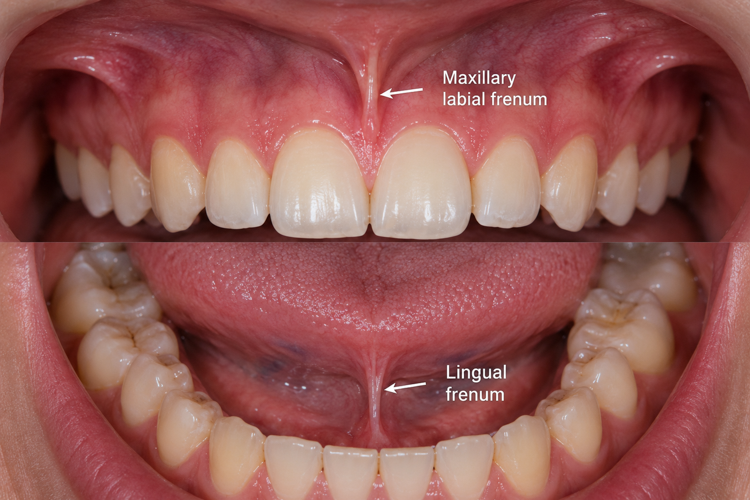
A frenum (plural: frena) is a small, normal fold of tissue that connects one part of your mouth to another. You have several. Put your tongue to the roof of your mouth and you’ll feel the lingual frenum stretching underneath. Run your tongue behind your upper lip and you’ll find the labial frenum connecting your lip to your gums. These bands are not defects. Everyone has them. They’re a standard part of human anatomy, the way an appendix or an earlobe is.
Sometimes a frenum is unusually short, tight, or attached in a way that restricts movement. When the lingual frenum limits how far the tongue can lift or extend, we call it a tongue-tie (ankyloglossia). When the upper labial frenum is thick or attaches low between the front teeth, people call it a lip-tie. The key word in all of this is restricts. A frenum that’s simply visible, or a little tight, is not automatically a problem that needs a scalpel or a laser.
What Is a Frenectomy?
A frenectomy (sometimes called a frenotomy or a frenulectomy, depending on the technique) is a procedure that releases or removes that band of tissue. In an infant, releasing a tongue-tie can be a quick clip with sterile scissors. In older children and adults, it’s usually done with a scalpel, electrocautery, or a laser, and it may involve a few stitches. It is, in the right situation, a legitimate and helpful procedure. I am not anti-frenectomy. I refer patients for them when they’re warranted.
When a Frenectomy Genuinely Helps
There are real, well-supported reasons to release a frenum. The clearest is a newborn who cannot latch or transfer milk effectively because the tongue truly can’t reach, after a skilled lactation evaluation has confirmed the tie is the cause and other fixes haven’t worked. Other legitimate indications include a lingual frenum so restrictive it demonstrably interferes with specific speech sounds that a speech-language pathologist has identified, or a labial frenum that pulls hard enough on the gum to cause recession or a stubborn gap that orthodontics alone can’t close. In those cases, releasing the tissue can change a child’s life for the better.
Notice the pattern: a specific, documented functional problem, evaluated by the right professional, that clearly traces back to the frenum. That’s the bar. When a case meets it, I’m the first to say let’s proceed.
The Part That Worries Me: Frenectomy Has Become Over-Medicalized
Here’s the uncomfortable truth in my profession. Diagnoses of tongue-tie in the United States increased nearly tenfold between 1997 and 2012, and then doubled again in the years after, and frenectomy surgeries climbed right alongside them, as researchers tracking the trend have documented. Human tongues did not suddenly change. What changed was how aggressively the procedure is diagnosed, marketed, and sold.
And the evidence underneath much of it is thin. A Cochrane review, the gold standard for weighing medical evidence, found that while releasing a tongue-tie may ease nipple pain for breastfeeding mothers, it does not reliably improve a baby’s actual feeding. The American Academy of Pediatrics has cautioned that when breastfeeding problems arise in an infant with a tongue-tie, the answer is not to jump straight to surgery, many babies do better with a thorough feeding evaluation and lactation support first. The Academy of Breastfeeding Medicine has gone further on the trendy “lip-tie” and “cheek-tie” diagnoses, stating there’s no reliable evidence to support surgery for them at all.
Meanwhile, laser frenectomies get marketed as a premium, high-tech upgrade, often several hundred dollars out of pocket, even though there’s no strong evidence a laser works better than a simple, careful release. When a procedure is diagnosed ten times more often than it used to be, marketed as urgent, and priced as a premium service, I think every parent deserves to pause and ask a hard question: is this being recommended because my child needs it, or because it can be sold?
A Tragedy Down the Road in Fort Worth
I don’t raise the next story lightly, and I share it with real sorrow for a family that lost everything.
In April 2026, a four-year-old girl named Aithana Arriaga died at a dental office in Fort Worth, about forty-five minutes from our Frisco practice, after undergoing a frenectomy. According to the medical examiner and investigators, she died of meperidine (Demerol) toxicity: a level of opioid that court documents described as high enough to be lethal. Investigators reported that staff could not immediately say how much sedative had been given, that the child’s respiratory distress wasn’t recognized in time, and that the wrong reversal medication was administered. The dentist was arrested and charged. Out of respect for the legal process, I’ll note those are allegations a court will weigh, not verdicts I’m rendering.
But here is the detail that has stayed with me, the one I can’t stop thinking about as a clinician and a father. According to reporting on the case, one of Aithana’s own physicians did not believe she had a tongue-tie at all and questioned why the procedure was being done. She was, by her doctors’ account, an otherwise healthy child with no breathing problems. You can read the reporting on the case here.
The conversation around this heartbreak has focused, understandably, on the sedation. And sedation safety matters enormously, there are clear pediatric sedation guidelines from the AAP and the American Academy of Pediatric Dentistry precisely because these medications carry real risk in small bodies. But I want to point at something upstream of the sedation. The safest complication is the one from a procedure that never had to happen. If the frenectomy was never truly indicated, then no dose, no monitor, and no reversal drug was ever the real safeguard. The real safeguard was the diagnosis, and the honesty to say, “Your child doesn’t need this.”
Our Position: Evidence-Based Dentistry, Even When It Means Doing Less
At Tribute Family Dentistry and Elate Orthodontics, we practice what’s called evidence-based dentistry. That’s not a marketing phrase to us. It means every recommendation has to stand on three legs at once: the best available research, my clinical judgment and experience, and your family’s specific values and circumstances. If a procedure can’t clear all three, we don’t do it, no matter how easily it could be billed.
In practice, that means a few things you can count on when you walk into our office near FM 423 and Lebanon:
- We diagnose function, not appearances. A visible frenum is not a diagnosis. We look at whether your child can actually feed, speak, and thrive, and we bring in lactation consultants, pediatricians, and speech-language pathologists when their expertise is what’s really needed.
- We’re comfortable recommending watchful waiting. Many “problems” a toddler is flagged for resolve on their own as they grow. Doing nothing, carefully and with follow-up, is often the most skilled thing a clinician can do.
- We’ll tell you when the answer is no. If your child doesn’t need a frenectomy, you’ll hear that clearly, and we’ll explain why in plain language.
- When a release is warranted, safety comes first: appropriate settings, conservative approaches, and honest conversations about sedation rather than reaching for it as a default.
What Frisco Parents Should Do Before Agreeing to a Frenectomy
If someone has told you your child in Frisco, The Colony, Little Elm, Prosper, or anywhere in the 423 corridor needs a tongue-tie or lip-tie procedure, please don’t feel rushed. A genuine anatomical restriction will still be there next week. Here’s what I’d tell my own family to ask:
- What specific, functional problem are we treating? “It might cause issues later” is not a diagnosis. Ask for the concrete problem happening now.
- Who else has evaluated this? For an infant, has an experienced lactation consultant assessed the feeding? For speech, has a speech-language pathologist weighed in? For a gap between teeth, has an orthodontist looked?
- What happens if we wait? Ask about the watchful-waiting option and what the real risk of waiting is.
- What sedation, if any, is being recommended, and why? Ask who is monitoring your child, what medications are used, and what the emergency plan is. You are always allowed to ask.
- Would you get a second opinion? Any provider confident in their recommendation should welcome one.
A trustworthy provider will never make you feel foolish for asking these questions. If asking them makes someone defensive or dismissive, that itself is an answer.
Common questions
Is a tongue-tie always a problem that needs surgery?
No. Many people have a tight or visible frenum with no functional issue at all. Surgery is warranted only when a restriction clearly causes a specific problem, like an infant who genuinely can’t feed, or a documented speech or gum issue, and conservative options haven’t resolved it.
Are lip-ties and cheek-ties real conditions that need release?
These diagnoses have become very popular, but the Academy of Breastfeeding Medicine says there’s no reliable evidence to support surgery for them in most cases. Be especially cautious here and seek a second opinion.
Is a laser frenectomy safer or better than the traditional method?
There’s no strong evidence that lasers produce better outcomes than a careful conventional release, though they’re often priced higher. The technique matters far less than whether the procedure is truly needed.
My baby was just diagnosed with a tongue-tie. What should I do first?
Start with a skilled lactation evaluation, not a scalpel. The AAP recommends addressing feeding problems with proper support before considering surgery. If a release turns out to be needed after that, you’ll be making the decision on solid ground.
Get a second opinion before you agree to it
If someone has recommended a frenectomy for your child, come talk to us first. We will tell you honestly whether we think it is warranted, including when the answer is that it is not.
You may also be interested in these
- When should kids start going to the dentist?
- Shark teeth: why the new tooth comes in behind the old one
- Do you know who owns your orthodontist?
About Tribute Family Dentistry
200+ five-star Google reviews • Family owned and independent • D Magazine Best Dentist 2026 • Living Magazine Readers' Choice 2026 • Se habla espanol
Tribute is a family owned, independent practice on FM 423 in Frisco. I own it with my wife, Dr. Julia Kang, DMD, MS. We both trained at Boston University and we are both members of the Omicron Kappa Upsilon national honor society. I am a Diplomate of the American Board of Orthodontics. Day to day, most patients and their kids see Dr. Christina Pham, DMD, our general and family dentist, and oral surgery is handled by Dr. David Roberts, DDS, who has been doing it for more than 35 years.
We handle the whole family in one place: cleanings and preventive care, fillings, crowns, bridges, implants, root canals, extractions and wisdom teeth, whitening, night guards, and emergency visits. Open Monday through Friday, 8:00 AM to 5:00 PM. Se habla espanol.
If you need braces or clear aligners, that is the other side of what we do. Elate Orthodontics, our sister practice, treats kids, teens, and adults out of three offices in Frisco and The Colony.
Tribute Family Dentistry
5605 FM 423, Suite 600-B, Frisco, TX 75036
Book an appointment: (469) 598-1021
About the author: Dr. Kevin Baharvand, DMD, MS is a Diplomate of the American Board of Orthodontics and a national speaker on clear aligner treatment. His clinical work was selected for the cover of the American Journal of Orthodontics and Dentofacial Orthopedics. He and his wife, Dr. Julia Kang, own Tribute Family Dentistry and Elate Orthodontics in Frisco, Texas.
