


6 min read • By Dr. Kevin Baharvand, DMD, MSD, MSOL • Updated November 2026
The short answer
Antibiotics can stop a tooth infection from spreading into your jaw, face or bloodstream, and they bring the swelling down. They can’t fix the tooth that started it. The bacteria live inside a tooth whose nerve has died, where there’s no blood flow to carry the drug, so the infection comes back unless the tooth gets a root canal or comes out. And for a plain toothache with no swelling or fever, antibiotics usually don’t help at all.
A common way this goes: the face swells on a Saturday, urgent care or a telehealth visit prescribes amoxicillin, and two days later the swelling is down and the pain is mostly gone. It feels fixed. A few weeks or months later, the same tooth flares up again.
That isn’t the antibiotic failing. It did its job, which was to calm the infection around the tooth. The source was never touched. Here’s what antibiotics do for a tooth infection, when they’re actually needed, which ones you’re likely to get, and what finishes the job.
On this page
Why antibiotics can’t cure a tooth infection
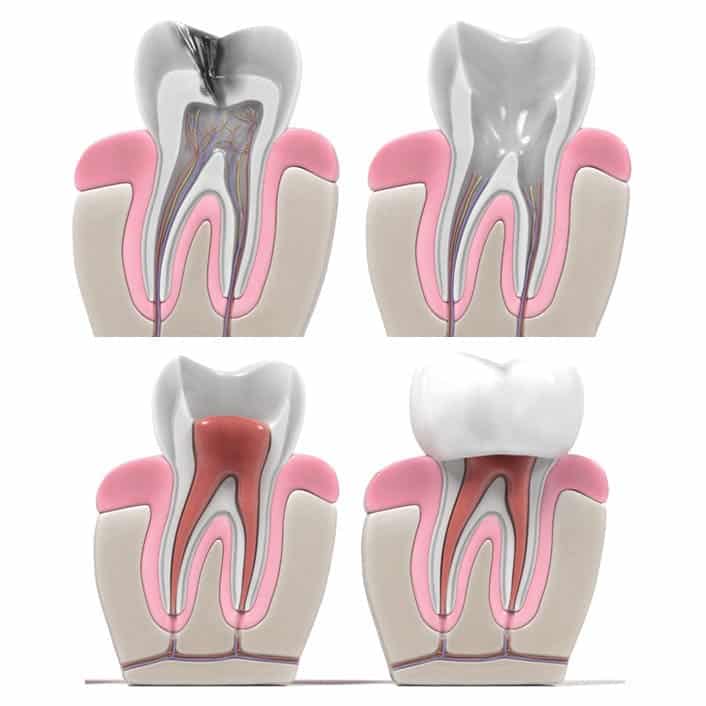
Most tooth infections start inside the tooth. Decay or a crack lets bacteria reach the pulp, the nerve and blood vessels in the center. The pulp dies, and the bacteria keep living in the hollow space it leaves behind, inside the root.
Antibiotics travel through the bloodstream. They reach the gum, the bone and the soft tissue around the tooth just fine, which is why swelling goes down. But a dead pulp has no blood supply, so the drug never gets inside the root canal in any useful amount. Once the course ends, the bacteria still sitting in there start the infection over.
So antibiotics buy time and make treatment safer. They aren’t the treatment. A dental abscess gets resolved by draining it and dealing with the tooth.
When a dentist does prescribe them
Antibiotics make sense when the infection is spreading beyond the tooth, or when your body is showing signs it’s fighting something bigger. That usually means one or more of these:
- Swelling in the face, jaw or neck, especially if it’s growing
- Fever, chills or feeling generally sick
- Swollen, tender lymph nodes under the jaw
- Trouble opening your mouth
- An infection that can’t be drained or treated right away, for example while you wait for a root canal appointment
- A weakened immune system, which makes any infection riskier
In those cases the antibiotic usually goes alongside treatment, not instead of it. If your face is swollen, our guide to why your face is swelling up covers which kinds of swelling need a same-day visit and which need the ER.
When antibiotics won’t help
A lot of tooth pain isn’t an infection that antibiotics can treat. The American Dental Association’s 2019 guideline on dental pain and swelling recommends against antibiotics for most toothaches in otherwise healthy adults when there’s no spreading swelling or fever. That includes:
- An inflamed nerve. The sharp, lingering pain from hot or cold, or the throbbing that keeps you up at night, often comes from a nerve that’s inflamed but not infected yet. Antibiotics do nothing for it
- A small, contained abscess. If the infection is limited to the tooth and the gum right around it, treating the tooth is what helps. The antibiotic adds side effects without adding much benefit
- Dry socket after an extraction. That’s a lost blood clot, not an infection. Our post on dry socket symptoms explains how it’s treated
There’s a reason the guideline is strict. Every course of antibiotics carries some risk of stomach trouble, allergic reactions, yeast infections and C. diff, and taking them when they aren’t needed feeds antibiotic resistance. If a dentist tells you that you don’t need one, it’s usually because the treatment itself is the faster fix.
Pain is a separate problem. Antibiotics aren’t painkillers. For tooth pain, the ADA’s 2023 guidance favors ibuprofen together with acetaminophen over opioids for most adults, if both are safe for you. Follow the label or what your doctor has told you.
Which antibiotics are used for a tooth infection
Your dentist chooses the drug and the dose based on your health history, allergies and what’s going on in your mouth. This is what you’re likely to see, not a guide to picking one yourself.
| Antibiotic | Usually used for | Worth knowing |
|---|---|---|
| Amoxicillin | First choice for most dental infections | Penicillin family. Tell the dentist about any penicillin allergy |
| Penicillin VK | Also a first choice | Same family as amoxicillin, narrower coverage |
| Amoxicillin with clavulanate (Augmentin) | An infection that isn’t responding to the first drug | Broader coverage, and more likely to upset your stomach |
| Metronidazole | Sometimes added to amoxicillin or penicillin when an infection is stubborn | No alcohol while you take it or for 3 days after |
| Cephalexin | Penicillin allergy without a severe reaction in the past | Not used if penicillin ever caused swelling, hives or trouble breathing |
| Azithromycin or clindamycin | Penicillin allergy with a history of a severe reaction | Clindamycin carries a higher risk of C. diff, a serious diarrhea infection. Call if you get watery diarrhea |
If you have a penicillin allergy, say exactly what happened when you took it. A rash years ago and a throat that swelled shut lead to different choices.
How fast antibiotics work and how long to take them
Most people notice the swelling and pain starting to ease within 2 to 3 days. If things are getting worse after 48 hours on an antibiotic, call. The drug may not be the right one, or the infection may need to be drained before it can settle.
Courses for dental infections tend to be short, often 3 to 7 days. Take it exactly as prescribed. Don’t stop early on your own because you feel better, and don’t save leftover pills for next time. A partial course of whatever happens to be in the drawer makes the next infection harder to treat.
What actually fixes a tooth infection
The fix is removing the source. Depending on the tooth, that’s one of these:
- Root canal. The infected pulp is cleaned out of the tooth, the canals are sealed, and the tooth is usually protected with a crown. It keeps your own tooth. At our office a root canal runs $600 to $1,600 depending on the tooth
- Extraction. If the tooth can’t be saved, it comes out. A simple extraction is $100 to $300, a surgical one $250 to $600 or more
- Draining the abscess. Releasing the pus brings fast relief and is often the first step on the day you’re seen
- Gum treatment. When the infection is in the gum rather than the tooth, cleaning out the pocket is what resolves it
An emergency exam with X-rays is $75 to $150. We work with most PPO plans, including Delta Dental, Aetna, Cigna, MetLife, Blue Cross Blue Shield, UnitedHealthcare and Humana. Without insurance, our Smile Savings Plan is $360 a year per adult and takes 20% off most treatment, and CareCredit and Cherry offer monthly payments. We don’t accept Medicaid or CHIP.
Our emergency dental visits page explains what happens when you come in with an infected tooth. We’re open Monday through Friday, 8 to 5. If it starts over a weekend, urgent care or a telehealth visit can prescribe an antibiotic to hold things steady, and then call us first thing on a weekday.
When a tooth infection is an ER problem
Go to the emergency room, not a dental office, if any of these are happening:
- Trouble breathing or swallowing
- Swelling spreading down the neck or up toward the eye
- A high fever with a swollen face
- Feeling confused, faint or very unwell
Those can mean the infection has moved into deeper spaces of the head and neck, which needs IV antibiotics and sometimes surgical drainage. The ER can stabilize you, but most don’t have a dentist on staff, so you’ll still need the tooth treated afterward. More on that in do emergency rooms have dentists.
Common questions
Can a tooth infection go away with antibiotics alone?
The symptoms can, for a while. The infection usually comes back because the bacteria inside the tooth are still there. A root canal or an extraction is what ends it.
How long can I stay on antibiotics instead of treating the tooth?
Antibiotics aren’t a long-term plan. Repeated courses lead to more side effects and more resistant bacteria, and each flare-up can do more damage to the bone around the tooth.
Can I get antibiotics for a tooth infection without seeing a dentist?
Urgent care, telehealth and the ER can all prescribe them, and that’s reasonable when you can’t see a dentist right away. You still need the tooth treated afterward.
Do I need antibiotics before a root canal or extraction?
Usually not, unless there’s spreading swelling or a fever. Some people with certain heart conditions or other medical issues are told by their doctor to take an antibiotic before dental work. If that’s you, let us know when you book.
Will antibiotics stop my toothache?
Only if the pain is coming from swelling and infection around the tooth. Pain from an inflamed nerve doesn’t respond to antibiotics. Ibuprofen with acetaminophen, if safe for you, usually helps more until the tooth is treated.
Can I drink alcohol while taking antibiotics for a tooth infection?
Not with metronidazole, which can cause a severe reaction with alcohol during the course and for 3 days after. With other antibiotics it’s still better to skip it, since alcohol slows healing and can add to stomach upset.
Tooth infection or swelling?
Call us during office hours, Monday through Friday, 8 to 5, and we’ll find you the earliest opening to look at the tooth and treat the source. We see patients from Frisco, The Colony and Little Elm.
You may also be interested in these
- Dental abscess: signs and treatment
- Why is your face swelling up?
- Do emergency rooms have dentists?
- Root canal treatment in Frisco
About Tribute Family Dentistry
200+ five-star Google reviews • Family owned and independent • D Magazine Best Dentist 2026 • Living Magazine Readers' Choice 2026 • Se habla espanol
Tribute Family Dentistry is a family owned, independent practice on FM 423 in Frisco. I own it with my wife, Dr. Julia Kang, DMD. We both trained at Boston University and we are both members of the Omicron Kappa Upsilon national honor society. I am a Diplomate of the American Board of Orthodontics. Day to day, most patients and their kids see Dr. Christina Pham, DMD, our general and family dentist, and wisdom teeth removal is handled by Dr. David Roberts, DDS. D Magazine named me a Best Dentist for 2026, and Living Magazine readers voted us Best Family Dentist in Frisco and Plano the same year.
We handle the whole family in one place: cleanings and preventive care, fillings, crowns, bridges, implants, root canals, extractions and wisdom teeth, whitening, night guards, and emergency visits. We are open Monday through Friday, 8:00 AM to 5:00 PM, we speak Spanish, we work with most major insurance plans, and we run an in house savings plan for families without dental benefits.
If you need braces or clear aligners, that is the other side of what we do. Elate Orthodontics, our sister practice, treats kids, teens, and adults out of three offices in Frisco and The Colony.
Tribute Family Dentistry
5605 FM 423, Suite 600-B, Frisco, TX 75036
Book an appointment: (469) 598-1021
About the author: Dr. Kevin Baharvand, DMD, MSD, MSOL is a Diplomate of the American Board of Orthodontics and a national speaker on clear aligner treatment. His clinical work was selected for the cover of the American Journal of Orthodontics and Dentofacial Orthopedics. He and his wife, Dr. Julia Kang, own Tribute Family Dentistry and Elate Orthodontics in Frisco, Texas.
