


What Is a Deep Cleaning of Teeth? A Real Talk Patient Guide
If your dentist or hygienist has told you that you need a deep cleaning, you might be thinking:
-
What is a deep cleaning of teeth, really
-
Does a deep cleaning hurt
-
How much does a deep cleaning cost
-
Can I refuse a deep cleaning at the dentist
You are not alone. Deep cleaning is one of the most confusing and misunderstood dental terms. Let us slow it down and walk through what is actually happening under your gums so you can make a decision that feels smart, not pressured.
First, How Do Gums And Pockets Actually Work?
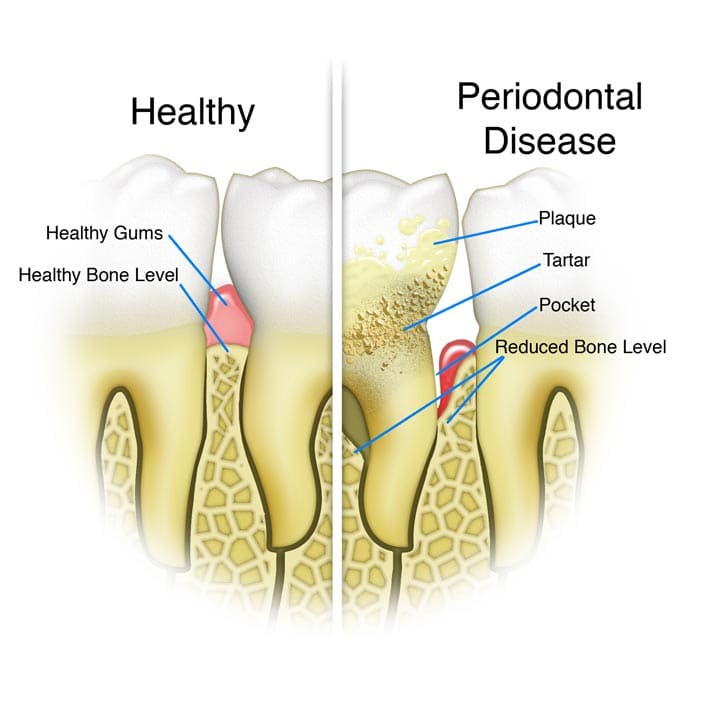
To understand what a dental deep cleaning is, you have to understand a little bit of gum anatomy. Nothing crazy, just the basics.
Every tooth has a natural little groove where the gum meets the tooth. That space is called the sulcus, or gingival sulcus. You can think of it like a tiny collar of gum that hugs the tooth.
-
In a healthy mouth, that sulcus is usually about 1 to 3 millimeters deep
-
It is shallow enough that you can keep it clean with daily brushing and flossing
-
The gums look pink, feel firm, and do not bleed easily
Now here is the important part:
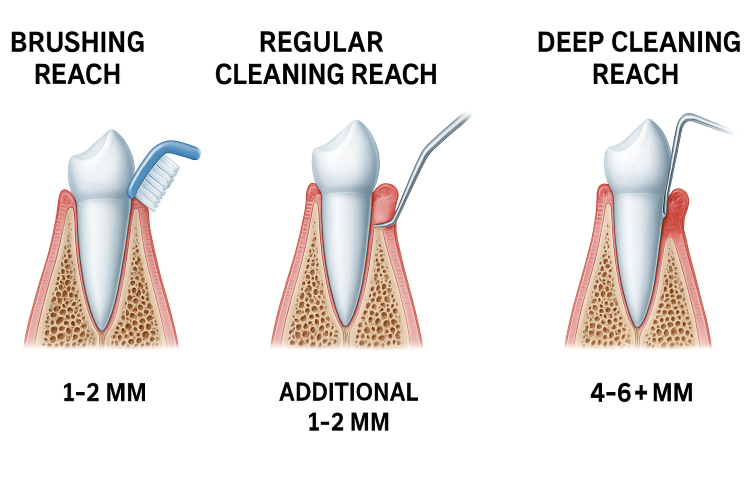
How far does brushing really reach?
When you brush at home, the bristles usually clean:
-
Everything on top of the tooth above the gumline
-
Plus about 1 to 2 millimeters down into that sulcus
That is it. No matter how expensive your toothbrush is, it is not reaching very far under the gum.
How far does a regular dental cleaning reach?
A regular cleaning at the dentist removes plaque and tartar:
-
Above the gumline
-
And again, maybe another 1 to 2 millimeters under the gum if the gums are healthy
So between your brushing and a normal cleaning, you might be getting:
-
2 to 4 millimeters of total cleaning coverage from the top of the tooth down into the sulcus
When the sulcus stays in that healthy 1 to 3 millimeter range, this is usually enough to keep things under control.
When A Healthy Sulcus Turns Into A Gingival Pocket
When plaque and tartar sit under the gum for too long, the body reacts. The gums get irritated, inflamed, and start to pull away from the tooth. That once shallow sulcus becomes a deeper pocket.
This is where you start hearing things like:
-
“You have 4, 5, or 6 millimeter pockets”
-
“You have early or moderate gum disease”
-
“You need scaling and root planing” or a deep cleaning
A gingival pocket is basically a sulcus that has gotten too deep for you to clean yourself. Remember:
-
Your toothbrush reaches about 1–2 mm
-
A regular cleaning reaches another 1–2 mm
-
Anything past that zone is now deep enough that bacteria can sit there, untouched, and quietly damage bone and gum
Once those pockets get to 4 millimeters and beyond, brushing and regular cleanings simply cannot reach deep enough to remove the bacteria and hardened tartar stuck to the roots.
That is exactly where deep cleaning at the dentist comes in.
So What Is A Dental Deep Cleaning, Exactly?
A dental deep cleaning is a treatment for gum disease called scaling and root planing.
In simple terms, it is:
-
A focused cleaning that goes deep under the gums
-
Removal of hardened tartar and bacteria from the root surfaces
-
Smoothing of the roots so the gums can calm down and reattach
Instead of just polishing the tops of your teeth, the hygienist gently slides under the gums to clean the parts you cannot reach at home.
A deep cleaning is usually done:
-
By quadrants (upper right, upper left, lower right, lower left)
-
With numbing, so you stay comfortable
-
Over one or two visits, depending on how many areas need treatment
It is not “just a stronger cleaning.” It is a medical treatment for gum disease and bone support.
Who Actually Needs A Deep Cleaning?
You typically need a deep cleaning when there is evidence of periodontal disease, not just a little plaque.
Signs that point toward needing scaling and root planing include:
-
Pocket depths of 4 millimeters or more on gum measurements
-
Bleeding when the gums are gently probed or when you brush and floss
-
X-rays that show bone loss around teeth
-
Tartar that is visible under the gum along the roots
-
Gums that look red, puffy, or are starting to shrink back
If all your pockets are 1–3 mm and there is no bone loss, a deep cleaning is usually not indicated. In that scenario, a regular cleaning and better home care are often enough.
Can You Refuse A Deep Cleaning At The Dentist?
Short answer: yes, you can. You always have the right to say no or to wait.
But here is the honest side of it:
Refusing a truly needed deep cleaning does not make the gum disease go away. It just means the bacteria stay in those deep pockets, and the body continues to slowly lose bone and support.
What you should absolutely feel comfortable doing is:
-
Asking, “Can you show me my pocket measurements?”
-
Asking, “Where exactly are my pockets 4, 5, or 6 millimeters?”
-
Asking to see your X-rays and having someone point out bone levels
-
Asking, “Are there any areas that could still be maintained with regular cleanings instead of SRP?”
If the explanation is rushed or you feel pushed without clear proof, it is completely reasonable to:
-
Pause
-
Ask more questions
-
Or get a second opinion
Good dentistry should feel collaborative, not like a sales pitch.
Does Deep Cleaning Teeth Hurt?
This is one of the biggest questions: does a deep cleaning hurt?
During the procedure:
-
The areas are usually numbed with local anesthetic
-
You might feel pressure, vibration, or stretching, but not sharp pain
Afterward, it is normal to have:
-
Mild soreness for a day or two
-
Some tenderness when you brush
-
Temporary sensitivity to cold
Most people describe it as “annoying but very manageable.” Saltwater rinses, a soft toothbrush, and a desensitizing toothpaste help a lot during the healing phase.
How Long Does A Deep Cleaning Take?
The time depends on how many teeth and pockets need treatment, but in general:
-
Per quadrant: about 60 to 90 minutes
-
Half the mouth in one visit: often around 1 to 1.5 hours
-
Sometimes the whole mouth can be done in one longer session if things are mild
Dentists typically split the mouth into two visits so that:
-
You are not numb everywhere at once
-
You can eat and talk more comfortably afterward
How Much Does A Deep Cleaning Cost?
There is no single price because it depends on:
-
How many quadrants need deep cleaning
-
How severe the pockets and bone loss are
-
Whether any localized antibiotics or medicaments are placed
Most offices charge per quadrant. Dental insurance often covers a portion of deep cleaning when gum disease is properly documented.
The key is transparency. You should be given:
-
A clear written estimate
-
A breakdown of what your insurance does and does not cover
-
A chance to ask questions before you commit
What Happens After A Deep Cleaning?
After a dental deep cleaning, the goal is healing and maintenance.
In the weeks that follow, you will likely notice:
-
Less bleeding when you brush
-
Gums that look less puffy and more pink
-
Maybe some small spaces between teeth where swollen gums have shrunk down
Your dentist or hygienist will usually bring you back in 6 to 8 weeks to:
-
Re-measure pocket depths
-
Check how well the gums are healing
-
Decide whether you should be on 3–4 month periodontal maintenance visits instead of every 6 months
Deep cleaning is the reset. Your daily brushing, flossing, and regular checkups are what keep you from needing it again.
How To Tell If A Deep Cleaning Recommendation Is Reasonable
Here is a quick checklist to help you feel more confident:
-
Did someone show you your pocket chart or at least explain where the deeper pockets are
-
Did you see your X-rays and understand where bone looks lower
-
Did they explain the difference between a regular cleaning and scaling and root planing in terms you understand
-
Did you feel free to ask questions without being rushed
If those boxes are checked, there is a good chance the recommendation is based on real findings, not just a script.
Looking For An Honest Opinion On Deep Cleaning?
If you are still unsure whether you really need a deep cleaning and want someone to walk you through your pocket numbers and X-rays in plain language, you can always get a second opinion.
If you are near Frisco, TX and want a conservative dentist who explains what is happening under your gums before recommending treatment, you are welcome to schedule a visit with Tribute Family Dentistry. We take time to show you what we see, talk openly through your options, and recommend deep cleaning only when it is truly necessary.
📍 Tribute Family Dentistry, 5605 FM 423, Suite 600, Frisco, TX 75034
📞 (469) 598-1021
🌐 https://dentistfriscotx.com/
